Blog Post
The Modern Student Recruitment Funnel: What It Looks Like Today

The Modern Student Recruitment Funnel: What It Looks Like Today
Higher education is facing a structural shift as the traditional linear recruitment model collapses. With total enrollment declining 9% since 2017, institutions are navigating an "enrollment cliff" where the old ways of "guiding" students no longer work. Today's students are self-directed, pragmatic, and highly sensitive to digital cues.
Why the Traditional Funnel Is History
The old Awareness → Inquiry → Application model is no longer predictive. Discovery is now a loop where students form deep opinions before an institution even knows they exist.
- The Rise of the Stealth Applicant: Nearly 50% of applicants now submit their application as their very first recorded interaction with a school. Now submit their application as their very first recorded interaction with a school.
- The Comparative Loop: Enrollment is no longer a one-way street; 40% of learners continue to consider other schools even after their initial inquiry, and 26% keep exploring even after applying.
- Invisible Decision-Making: 65% of parents make preliminary decisions about schools before ever making direct contact.

Reframing the Model: The "Messy Middle" Loop
Instead of progressing through predictable funnel stages, modern students move repeatedly between two core behaviors:
Exploration
Students expand their list of options by:
- Researching programs
- Watching student-created content
- Comparing institutions
- Asking questions through AI tools
- Reading reviews and rankings
Evaluation
Students narrow their choices by assessing:
- Cost and financial aid
- Career outcomes
- Academic quality
- Campus experience
- Institutional reputation
Rather than moving neatly from awareness to enrollment, students cycle between exploration and evaluation multiple times before making a final decision.
For enrollment leaders, the challenge is no longer simply generating inquiries. It remains visible and credible throughout this decision loop.
The modern enrollment journey is fragmented, nonlinear, and highly personalized.
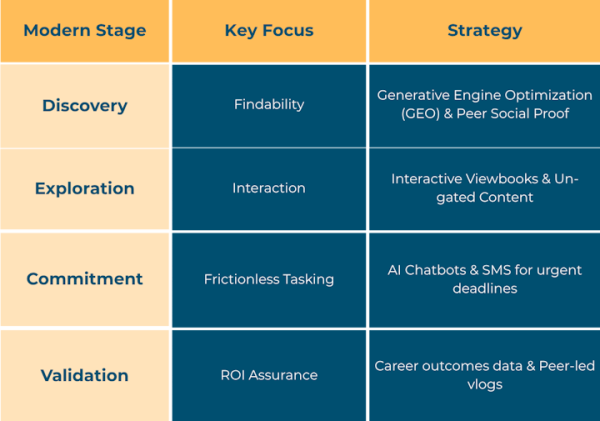
Discovery
Students often begin researching institutions long before they identify themselves as prospects. Discovery now happens through social media, peer networks, and AI-powered tools. Current students play a significant role in shaping perceptions, with 95% of prospects seeking peer input. Key channels include Instagram, YouTube, and TikTok, while generative AI helps students evaluate program value, career outcomes, and institutional fit.
Exploration
Once interest is established, students engage in a longer research process. Most do not make decisions after a single interaction and typically require seven to thirteen meaningful touchpoints before taking action. Institutions must maintain engagement despite growing communication fatigue and increased competition, as the average applicant now applies to 6.8 institutions, with many applying to ten or more schools.
Validation
As students narrow their options, they seek evidence that an institution is the right choice. Personalized experiences become critical at this stage, with nearly 69% of students expecting communications tailored to their interests and behaviors. Effective institutions leverage engagement signals such as program page visits, virtual tour participation, event registrations, and content interactions to deliver relevant information and reinforce fit.
Commitment
The final stage is about helping students confidently move from consideration to enrollment. Success depends on creating a connected experience that remains relevant throughout the decision-making process. Rather than maximizing the number of interactions, institutions should focus on delivering the right message at the right time, reducing friction and supporting students as they make their final enrollment decision.
The Modern Enrollment Playbook: Mapping Strategy to the Student Journey
Practical Hallmarks for Success
To bridge the gap between consumer expectations and institutional reality, schools must adopt:
- Frictionless Services: Administrative assistants like Northeastern's MyHusky answer 300+ common questions via voice/chat to reduce bureaucracy.
- Proactive ROI: Integrating career preparation throughout the journey to satisfy the 65% of students who say "value for money" is their top priority.
- Progressive Disclosure: Providing high-level overviews and letting students "pull" detailed data only when they are ready, respecting their cognitive load.
The New Enrollment Paradigm: From Managing Funnels to Empowering Journeys
The evidence confirms that the linear funnel is an obsolete map for modern students. To thrive in a climate of declining enrollment and high cost-sensitivity, institutions must transition from "controlling the flow" to "supporting the journey". The schools that succeed will be those that embrace the Messy Middle, respond with the extreme speed required to be the first to admit, and leverage behavioral data to provide a hyper-personalized experience. Ultimately, the goal is no longer to guide a student through a series of gates, but to become the most authentic and helpful resource in their self-directed search for value.
EDUTECHLoft: Your Strategic Partner in Improving the Student Lifecycle Journey
|
Whether you're just starting to identify where your student experience falls short or aiming to speed up ongoing improvements, we apply our methodology and higher education expertise to ensure lasting results. The institutions that win enrollment aren't the ones with the biggest campaigns. They're the ones where every interaction, from the first inquiry email to the financial aid conversation, deliberately earns trust. For more information on how we can help you, schedule a meeting with us and discover how we can help your institution grow! |