Blog Post
Aligning Marketing and Admissions: The Key to Higher Conversion Rates

Aligning Marketing and Admissions: The Key to Higher Conversion Rates
In higher education, the structural divide between marketing and admissions is a silent yield killer. Historically, these two departments chase conflicting goals. Marketing focuses on front-end visibility, celebrating vanity metrics like web traffic and click-through rates. Admissions, meanwhile, is judged on bottom-of-funnel lagging indicators like completed applications and actual enrolled headcounts.
This disconnect breeds a volume-over-quality mindset. Marketing floods the system with low-intent leads to hit inquiry targets, leaving admissions teams overwhelmed by prospects who have no real intention of enrolling.
The cost of this misalignment is staggering:
- High Acquisition Costs: The average Customer Acquisition Cost (CAC) in higher education consumes 12% of total unit revenue. Every lost lead directly erodes institutional margins.
- Wasted Capacity: The average course capacity utilization rate sits at 63%, meaning campuses have plenty of physical and digital space to scale if they can fix the leak.
- The Conversion Gap: Overall funnel conversion (from first touch to enrolled student) sits at a meager 3% to 5%, while the average admitted-to-enrolled yield rate is just 20%..
To win in a contracting demographic market, institutions must transition from measuring broad visibility to securing true lead viability.
Mapping the Funnel Together
Prospective student behavior has undergone a digital-first revolution. Today’s prospects are highly independent researchers who consult social proof and AI search engines long before talking to a counselor. In fact, nearly 10% of modern applicants are "stealth applicants" who apply directly without ever submitting a prior inquiry.
The 2025 E-Expectations Trend Report highlighted key digital realities that both teams must co-own to prevent drop-offs:
-
- Website Friction: 91% of students use the college website to research, yet 25% struggle to find info on specific majors.
- The Power of Virtual: Interactive virtual tours increase a student’s likelihood of applying by 65%.
- Email is Still King: 87% of students check their email weekly, and 74% prefer it for college communication.
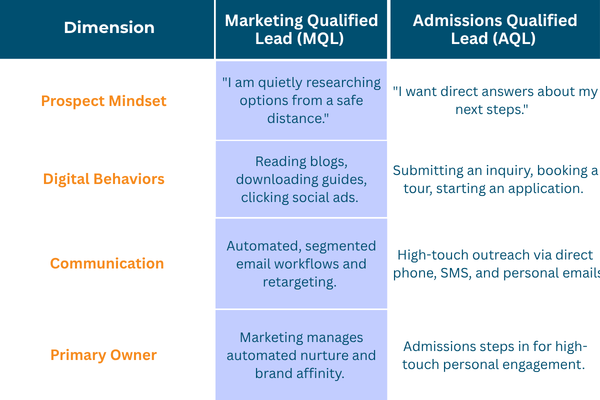
The Lead Qualification Framework: MQL vs. AQL
To stop admissions counselors from wasting time chasing cold leads, institutions must establish a shared lead qualification framework. By defining clear definitions, both teams understand when a prospect is ready for a human conversation.
Designing a Predictive Lead Scoring Model
A predictive lead scoring model converts qualitative behaviors into a quantitative 100-point scale, dynamically routing hot leads to counselors while keeping cooler leads in automated nurturing tracks.
A robust higher education scoring system incorporates both demographic fit and behavioral action triggers:
- Attending a physical or virtual campus event: +30 points
- Following primary social media channels: +20 points
- Aligning with target academic profile (GPA/test score): +15 points
- Downloading a program prospectus or career guide: +15 points
- Visiting the application or tuition page: +10 points
- Living outside the commuter-friendly 25-mile radius: -15 points
- Failing to open three consecutive email campaigns: -10 points
Implementing this model requires unified CRM architecture. Techno solutions Slate provides purpose-built admissions, portal, and application tools directly out of the box. Salesforce Education Cloud offers enterprise-wide platform flexibility and highly advanced predictive AI capabilities via Einstein, though at a significantly higher total cost of ownership.
Speed to Lead: The Ultimate Conversion Driver
Immediacy is no longer a luxury, it is an enrollment strategy. A staggering 72% of modern learners will choose to enroll at the very first institution that offers them admission. of modern learners will choose to enroll at the very first institution that offers them admission.
The numbers show that speed is a winner-takes-all game:
- The 5-Minute Rule: Responding to an inquiry within five minutes is up to 21 times more effective than waiting 30 minutes.
- The Human Gap: Despite this, 70% of student inquiries never receive a human response because admissions staff are bogged down by repetitive paperwork.
- Decision Velocity: 65% of applicants expect an admissions decision within one week. High-performing schools complete application reviews in 3 to 5 days, compared to the 5-to-10-day industry average.
Speed must be paired with message consistency. If marketing captures an adult learner with a message about "flexible night classes," but admissions follow up with a generic, canned email about traditional campus housing, the narrative disconnect will cause the prospect to slip away.

Strategic Action Items for Leadership
To transform your enrollment pipeline, execute these four strategic plays:
- Conduct a Friction Audit: Remove complex forms. Breaking applications into smaller, mobile-friendly steps with progress bars and "save-and-resume" options prevents drop-off.
- Establish SLAs: Codify Service-Level Agreements defining what makes a lead "admissions-ready" and mandating a maximum response window (e.g., under 15 minutes) for new inquiries.
- Unify the Tech Stack: Bring marketing and admissions data together into one CRM system (Slate or Salesforce) to maintain a single source of truth for every student record.
- Deploy Conversational AI: Integrate 24/7 AI chat agents to instantly capture inquiries, answer cost questions, and book counselor meetings overnight and on weekends.
A Unified Approach to Higher Conversion Rates
Higher conversion rates don't come from generating more leads, they come from creating stronger alignment between marketing and admissions. When both teams share goals, definitions, data, and accountability, institutions can deliver a more seamless prospective student experience, respond faster to intent signals, and focus resources on the leads most likely to enroll. In an increasingly competitive enrollment landscape, breaking down departmental silos is no longer optional; it's a strategic advantage that directly impacts yield, efficiency, and long-term growth.
From First Click to Classroom Seat: Close the Conversion Gap with EDUTECHLoft
|
EDUTECHLoft Support® bridges the gap between marketing outreach and admissions conversion by boosting your staff rather than straining them. For more information on how we can help you, schedule a meeting with us and discover how we can help your institution grow. |