Blog Post
When Technology Becomes a Barrier: Rethinking EdTech Integration in Higher Education

When Technology Becomes a Barrier: Rethinking EdTech Integration in Higher Education
When Technology Becomes a Barrier: Rethinking EdTech Integration in Higher Education
Most university technology leaders can name platforms. The LMS. The SIS. The advising tool. The student’s success dashboard. The early-alert system. The portal. The analytics layer. The list grew one procurement decision at a time, each tool justified, each vendor evaluated, each contract signed.
Yet across institutions, a familiar frustration persists: more technology, more complexity, and no clear improvement in the outcomes that matter: retention, completion, student satisfaction, and operational efficiency.
This is not a technology failure. It is a strategy failure. And the research is unambiguous about why.
EXECUTIVE SUMMARY
Higher education institutions are investing heavily in EdTech, while research shows that the conditions required for those investments to work, aligned infrastructure, governance, and faculty support, are systematically underfunded. The result is a widening gap between spending and outcomes.
Key findings covered in this blog:
- Across 79 universities, technological infrastructure scored 2.35/5.0 and institutional support 2.80/5.0, both below the neutral midpoint.
- Only 25% of higher education institutions believe their data infrastructure is structured ideally for analytics needs.
- 68% of teachers report their LMS does not integrate well with one or more learning applications.
Faculty resistance, inadequate infrastructure, and absent institutional policy are the three most consistent barriers to EdTech impact across a 21-study systematic review.
The Procurement-First Problem
Higher education institutions should avoid choosing tools before clearly defining the problems they aim to address, as this can lead to infrastructure that functions separately from, rather than is aligned with, institutional priorities.
A 2025 comparative study across all 79 nationally accredited Kenyan public universities measured this gap with precision. Using the UTAUT-2 framework across 1,183 respondents, students, faculty, and administrators, the study produced the following readiness scores on a 5-point scale:
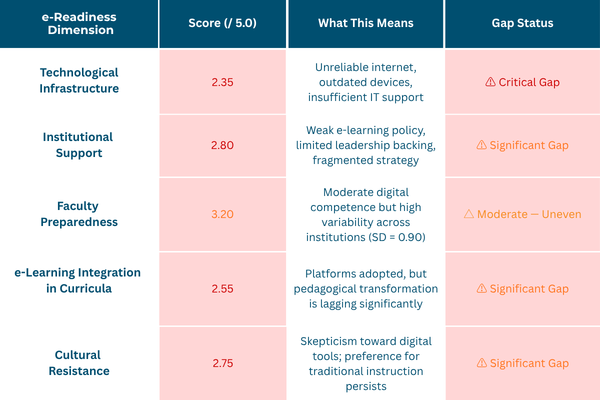
Source: Riany et al. (2025), Higher Education Research, Vol. 10(4). Score = mean on 5-point Likert scale; 3.0 = neutral midpoint.
The structural misalignment here is significant. Faculty preparedness, the only dimension above the neutral midpoint, means that willing instructors are operating in environments that cannot support them. Infrastructure and institutional policy, the very conditions that determine whether any platform produces value, score lowest of all.
This mirrors a pattern EDUCAUSE has tracked across U.S. institutions. In its 2024 Horizon Action Plan on Unified Data Models, an EDUCAUSE Quick Poll found that just one in four (25%) higher education institutions believed their data infrastructure was structured ideally for their analytics needs, and only 16% said their institutional data functions operated cohesively. Buying more platforms into a fragmented data environment does not close that gap. It widens it.
"Technology availability does not translate into instructional improvement without a coherent strategy." — Olawale, Omodan & Saddiq, Frontiers in Education (2025)
What This Looks Like in Practice: A Composite Case
A composite mid-sized university added eight platforms over five years, LMS, SIS, advising, student success, early-alert, CRM, career portal, and learning analytics, each purchased separately, with no unified data strategy. By year three, IT had built four custom integrations just for basic data exchange, two systems still required weekly manual reconciliation, and staff had resorted to spreadsheet workarounds because platforms couldn't share data fast enough for real decisions.
Faculty use of the LMS stayed limited to syllabus posting and grade submission. EDUCAUSE research confirms this is typical, only 41% of faculty use the LMS to promote interaction outside the classroom, meaning most advanced features go unused.
An internal review found three platforms had overlapping functionality, two were underutilized by more than half their target users, and only one had any outcome metric tied to renewal. The institution was paying for a portfolio it couldn't evaluate or fully use.
A 2024 MarketsandMarkets survey of 1,500+ teachers found 68% reported poor LMS integration with other learning applications. When gaps are this pervasive, people become the workaround, and the costs fall on staff time, faculty patience, and IT capacity rather than governance.

The Financial Consequences Leadership Rarely Sees
Consider where the money goes when platforms are poorly integrated:
- License renewals for platforms with low adoption rates, institutions regularly renew tools without utilization benchmarks, making it politically easier to continue than to justify discontinuation
- Custom integration development, building one-off connectors between systems that were never designed to communicate; industry estimates for enterprise software integration projects in higher education range from tens to hundreds of thousands of dollars per connection, depending on complexity
- IT staff time absorbed by legacy system support, troubleshooting platform incompatibility, and manual data reconciliation, hours diverted from strategic infrastructure work
- Administrative labor cost transferred to staff, when systems don't integrate, people do the integration manually; this is the hidden workforce cost of platform sprawl
These costs rarely surface in a line item labeled "waste" or "inefficiency." They appear as overtime, delayed projects, staff turnover, and deferred maintenance. EDUCAUSE's 2024 Top 10 IT Issues notes that technology expenses in higher education are rising faster than general operating costs, driven by inflation, workforce competition, and compounding legacy obligations, precisely the conditions platform sprawl creates and accelerates.
Separately, only 13% of higher education institutions describe themselves as actively engaged in digital transformation today, with the remaining 70% still in exploratory or strategy-development phases. For institutions in the majority, every year of drift compounds technical debt: more platforms, more integrations to maintain, and a widening gap between current infrastructure and the coherent digital environment that student outcomes actually require.
The spending continues. The outcomes don't follow. That gap has a financial signature; it just doesn't appear on the EdTech invoice.
Stakeholder Resistance Is a Data Point, Not a Culture Problem
A systematic review published in Frontiers in Education synthesized findings from 21 empirical studies on e-learning barriers across higher education institutions globally. Among the four primary barriers identified, lack of motivation, technical issues, faculty resistance, and inadequate infrastructure, the pattern across studies was consistent: faculty resistance was not the cause of EdTech failure. It was the signal.
Faculty who resist new platforms are often responding rationally to tools that disrupt established workflows without providing commensurate value. When that resistance is interpreted as a training problem rather than a design problem, institutions invest in adoption campaigns for systems that were never fit for purpose.
The EDUCAUSE 2025 Students and Technology Report found that student satisfaction with technology services was directly linked to two variables: the quality of campus internet and Wi-Fi and instructors' effective use of technology. These are not independent factors. When instructors don't use platforms effectively because the platforms are poorly aligned, poorly integrated, or poorly supported, student satisfaction with technology declines. That decline has downstream effects on engagement, retention, and institutional reputation.
EdTech decisions made through a procurement lens rather than a pedagogical one consistently produce tools chosen for feature sets rather than instructional fit. Changing that requires structural changes to who is in the room when decisions are made, not to change management communications after the contract is signed.
What a Strategic Approach Actually Looks Like
The research across these studies converges on four conditions that distinguish high-performing EdTech environments from those that stagnate. Each has a measurable institutional indicator attached.
- Problems before platforms. Define the specific institutional challenge, a retention gap, an advising bottleneck, or a completion rate shortfall, before evaluating technology. If you cannot state which institutional KPI platform is designed to move, the procurement decision is premature.
- Integration as a primary selection criterion. Interoperability with existing systems is not a post-purchase consideration. With 68% of institutions reporting integration failures across platforms, the human and financial cost of bridging that gap will exceed efficiency gains in most scenarios. Evaluate integration before features.
- Governance that includes academic leadership. Between institutional support scores and perceived e-learning quality. Cross-functional governance, faculty, IT, institutional research, and academic leadership arethe mechanism that make adoption sustainable. It is not overhead. It is the decision architecture that prevents misalignment.
- Outcome metrics tied to license renewals. Measure what changes in retention, time-to-degree, faculty workload, and student satisfaction, not logins and session counts. The question at renewal is not whether a platform is being used. It is whether it is producing the institutional outcome that justifies its purchase.

The Decision Facing Institutional Leaders
Higher education is operating in the tightest fiscal environment in a decade. Enrollment pressures, declining public funding, and workforce costs are compressing institutional margins, leaving little room for technology that does not demonstrably perform.
Every platform that is underutilized, poorly integrated, or misaligned with academic priorities represents a dollar not available for student support, faculty development, or the infrastructure that produces measurable outcomes. That is the real cost of procurement-first EdTech strategy, not the license fee, but the opportunity cost of institutional capacity that never materialized.
Digital transformation is not a procurement exercise. It is an institutional design challenge. The universities making it work are not adding more tools; they are building fewer, better-integrated systems governed by strategy and evaluated against outcomes that matter.
The question is not whether your institution has EdTech. The question is whether your EdTech has a strategy.
Ready to evaluate your EdTech strategy against what the research says works?
|
Schedule a meeting with our team! We work with higher education institutions to align technology investment with measurable institutional outcomes. |